
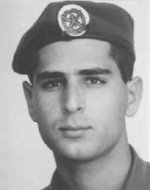
Dr. Maher Dagesh(Captain)
His life story
Maher was born on September 16, 1970 in the village of Magar. Already in his childhood, he stood out for his extraordinary intelligence and endless curiosity about the world around him. He began his studies at the "Magar B" elementary school and graduated with honors, and then continued on to middle school and high school in the village. Maher was a brilliant student, loved by his teachers and friends, full of initiative, joy of life, and interest in every field. He was endowed with an impressive ability to express himself and a wide knowledge, sometimes surprising those around him with words and concepts that even adults did not know. Throughout his years of study, he received certificates of excellence, and in the matriculation exams, he completed an excellent certificate.
He loved to read and research on science, medicine, art, philosophy, and computers. His friends used to call him a “walking encyclopedia” due to his vast knowledge and impressive ability to discuss any topic in depth.
After completing his studies, he took the psychometric exam and was accepted into the reserve medical studies at the Hebrew University of Jerusalem. In October 1988, he enlisted in the IDF as part of the reserve program, and during his studies, he completed an officers' course. Upon graduation, he received a Doctor of Medicine degree from Hadassah Ein Kerem University Hospital, and began his internship at Rambam Hospital in Haifa. In every department in which he worked, he excelled in his professional level, his humane approach, and his respectful attitude toward patients and staff alike.
Upon completion of his internship, he began serving in the IDF as a battalion doctor in the Golan Brigade of the Infantry. He accompanied the battalion in training and operational activities in the territories, and earned many praises for his professionalism, responsibility, and uncompromising dedication. The commander awarded him a medal of excellence for his exemplary performance, and later he was also awarded a medal of excellence from the Chief of Staff. Maher believed that every person is equal, no matter who they are, and advocated the statement that guided him: "We are all sons of one father and mother."
During his service, he demonstrated leadership, initiative, and original thinking, especially in his ability to combine medical principles with combat and field needs. In Lebanon, he joined operational activities alongside elite units, who sought to integrate him due to his professionalism and high fighting spirit. In addition to his service, he continued his academic studies and completed an additional degree in philosophy. A month before his fall, he married Samira, the love of his life.
On the night of September 5, 1997, Dr. Maher Dagesh set out with a force of fighters from Squadron 13 for operational activity in Lebanon. During the operation, the force was ambushed by terrorists. Several IEDs were detonated near it, and a fierce battle ensued that lasted for hours. At dawn, the harsh result became clear - Maher was killed along with eleven of the force's fighters: Lieutenant Colonel Yossi Corkin, Major Dr. Tzachi Bentov, Captain Ram Levinas, Captain Zvi Grossman, Sergeant Major Raz Tavi, Sergeant Major Aryeh Abramson, Sergeant Major Yohanan Hilberg, Sergeant Major Guy Golan, Sergeant Major Gal Rudovsky and Sergeant Major Yaniv Shmuel. Sergeant Major Itamar Ilya was declared missing that night and was laid to rest in Israel in June 1998.
Dr. Maher Daghesh died at the age of twenty-seven. He was laid to rest in the cemetery in the village of Majar in the Galilee. He left behind a wife, parents, and six brothers and sisters – Tajrid, Jumana, Ra'a, Tair, Tlia and Motia. After his death, he was promoted to the rank of captain.
Among his estate was a manuscript of a book dealing with traditional medicines, which he had printed shortly before his death – but which had not yet been published.
The commander of the Golan Brigade wrote to his family: "Maher's path is full of concepts of excellence. He excelled in medical studies, in his role in the army, and was even chosen to be the outstanding officer of the Golan Brigade before the Chief of Staff. His excellence was accompanied by a deep and genuine appreciation of his soldiers in the unit and his fellow commanders, as well as a high professional level, which he constantly maintained. Alongside his excellence, he knew how to be a true friend... Maher left us prematurely. His image, character, and qualities will accompany us onward and serve as a role model. The Golan Brigade is proud of Maher and salutes him."
On the evening held in memory of Maher, a week after his fall, the commander of the battalion in which he served spoke: "As someone who worked with him for an entire year, throughout his entire role as a battalion doctor, I can attest to his professionalism both as a doctor and as an officer. A combination of the ability to see things in a command, military, and combat-oriented way, together with the professional vision as a doctor and someone who cares first and foremost about the health of the soldiers. Dr. Maher was a first-rate advisor to me, explaining and clarifying issues that I had not always been able to understand. Maher had a sharp and observant eye, an open and understanding heart, and excellent analytical skills that allowed him to get to the bottom of things... His main commitment was to the aspect of physiological health, but Maher understood and acted extensively in the area of feelings and morale in the unit. Dr. Maher initiated and conducted surveys and conversations with soldiers in order to bring to our attention, the commanders, moods and feelings that had not come to our attention. In these actions, he proved that "He is an integral and central part of the battalion's command structure."
Maher's friend, the battalion's deputy commander, wrote in his memory: "I will always remember Maher as a doctor and an officer, but first and foremost as a friend. As a doctor, he had this amazing ability to look at a person walking towards him from a distance and tell whether he was faking it or sick, and if so, what kind of illness he had. As a doctor, he knew how to sit for hours with 'problematic' people and get them back to their best, and for that I owe him a lot. As an officer, he did his job admirably, always knew how to analyze situations and was a partner in making decisions and procedures. But with all of this, we had the little moments together when we would forget about ranks and positions and run around like two little children. We would have 'heart-to-heart talks' about life in the middle of the night, while covering for performances in the fields or during breaks in training, and immediately when necessary - return to real life, to the army... It is always customary to use many words, but in this case I think that words are too small to contain and describe the greatness of this man."
His unit mates wrote: "In every situation, whether it was during a wet and difficult winter training or on a warm summer day in the clinic over a cup of coffee, whether at an event with casualties or at an officers' evening in one of the pubs in the area, Maher was always the considerate, fatherly one, who cared for everyone and tried to solve the problems. He was always the one who found the bright spots, the good in the bad and made us all feel better. A man whose light went out prematurely, but his light will continue to illuminate our lives."
Other members of the team wrote in his memory: "We never praised you to your face... You never liked or needed to hear praise from us. Your pride and professional confidence and the fact that you were an autonomous person and your uncompromising independence always gave a feeling of 'there is nothing to add.' And now, when it is too late, the more we add and say, the more we will not be able to exhaust everything that could and should have been said. However, there are a few things we learned, that we loved, that we will remember and not forget from you: the humanity and empathy in your relationship with patients and people in general, the professionalism, perfectionism, being a doctor in every sense of the word, the support you always knew how to give us, the vast knowledge we absorbed from you, our mind-expanding conversations on various and varied topics - from philosophy to economics, politics and of course medicine to history, theology and what not, the morality and ethics that you zealously maintained, the Our countless shared experiences, the vast spectrum of thoughts, views, and emotions that filled you and are now an inseparable part of us.
Maher is commemorated by hand for the fallen of the Navy in Ashdod and at the memorial site for the fallen of the Medical Corps in Haifa.
Video gallery
His resting place
Hungarian Military Cemetery
Dedications and Memories
We strive to present only respectful content on the site that is appropriate to the memory of the fallen. If you encounter inappropriate, offensive, false or violent content, you can report it using the report button. The site team that receives the request will review the content and, if it turns out that it does not meet the terms of use, will edit or remove it, subject to the system's considerations. For any additional questions or comments, you can contact us at 03-55555555.
Number of dedications to the late Dr. Maher Dagesh: 1
Preserving the memory of the fallen soldiers of Israel's wars is the path of our work, and in its light we walk, in memory of our loved ones forever, until "for as long as I remember your words, I will remember you again."
Memorial Day for the Fallen in the Israeli Forces 2025